
The Magic Shadow Show
A birthday, a writing course and a rabbit hole.

My father would have been 104 today. I only knew him for 29 of his 78 years which means I have lived 25 years without him. I’m luckier than some, not so lucky as others. My stepchildren never knew him. I wish I had known him better. This week I have gone a little off piste and would like to share with you an essay I wrote about him a few years ago whilst on a Creative Non-Fiction course with Dan Richards at the National Centre For Writing. I do love a course/workshop/retreat and find them a valuable reset for when I am feeling set in my ways or flattened by Raging Imposter Syndrome. On this occasion I took the opportunity to try to learn more about the quiet, rather taciturn man who was my father. As is often the way of these things, I fell down an interesting rabbit hole. I hope you enjoy it.
There is so little left when our parents leave us. We grow up and become orphans - such a peculiar feeling.
The endings mount; the last time I spoke to dad before he was put into an induced coma, the last whispered words I said to him as they turned the ventilator off and he slipped away, the last time I saw him in the funeral home, smart in his navy suit but bloated, stone cold and unfamiliar when I held his hand.
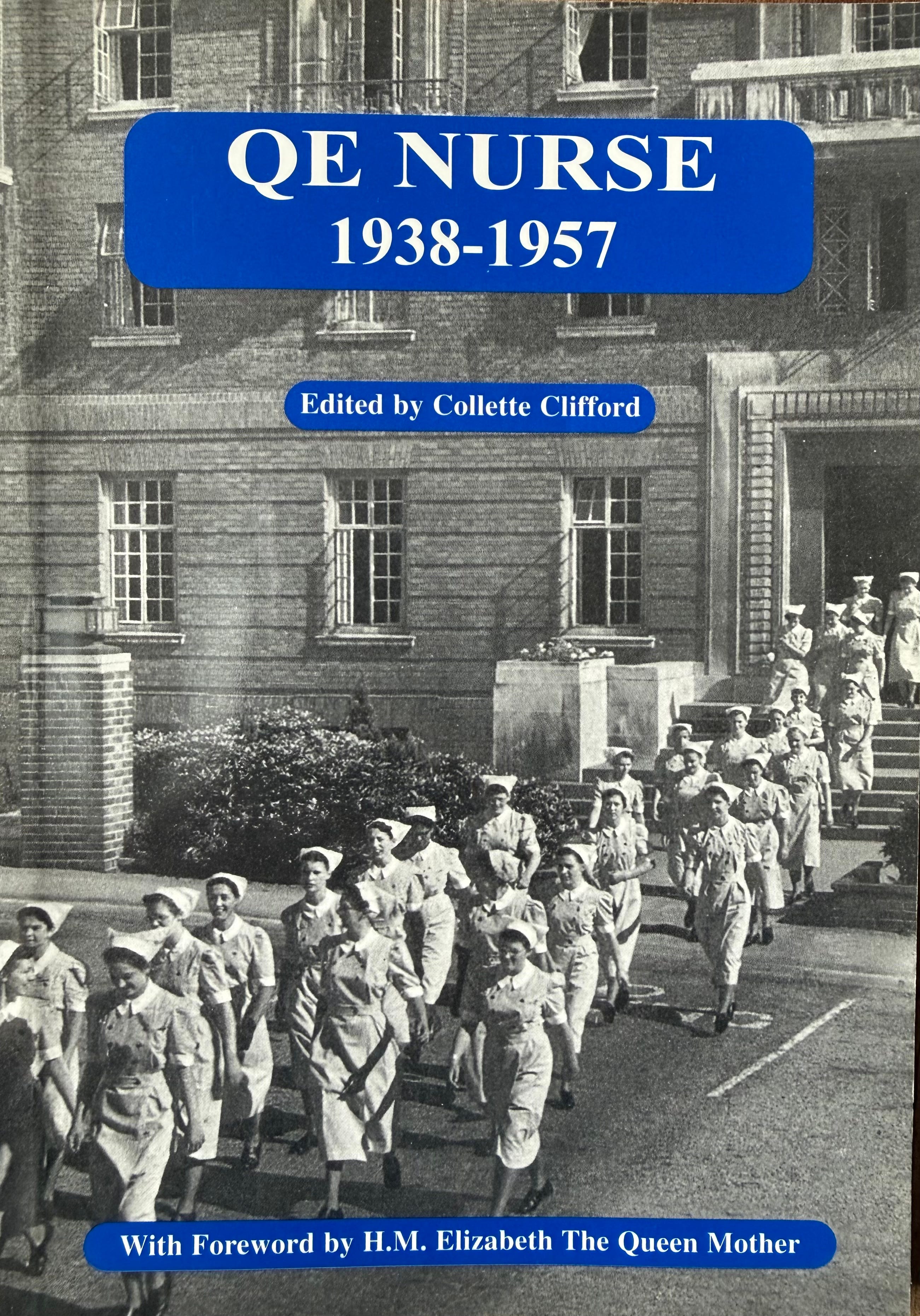
Searching for clues through my parents’ house after my mother’s death, I realised whatever was here would be all we ever had. His war medals, a Japanese good luck flag taken from a dead soldier, their wedding photos, scraps of memories from my brothers and sisters about his experiences in WWII in Burma. Our individual recollections of him - recycled and embellished each time we get together but yet, always the same. Tucked in amongst dad’s war memoirs and mum’s Georgette Heyer novels, I find a little book entitled “QE Nurse 1938-1957” - a slim, rather starchy but informative volume compiled by the Queen Elizabeth Hospital Nurses League.
Flipping through the pages, I realise this was the hospital dad was in when he returned from fighting in Burma with one lung peppered with bulletholes. The cover photograph shows the imposing art deco stone doorway of a large brick building surrounded by Crittal windows and topped with a stone balcony. Nurses are marching out of the door and down the steps of the hospital. The photograph is monochrome but a detailed description of uniform inside the book floods the photograph with colour.
The nurses were junior students in their first two years of training, indicated by the ‘short tail’ on their pert, white starched caps and their corn yellow uniforms with double breasted bibs and soft white collars and cuffs, designed by Norman Hartnell - dressmaker to the royal family. Brown stockings and brown shoes completed the look. They look smiling, fresh and purposeful and their procession so ordered it seems to strike a rather sad contrast to the state of the soldiers who would start arriving less than a year after the hospital opening.
I open the book and two letters flutter to the floor. The A4 typed pages separate and I see the last page of one. A verse from Omar Khayam, the 11th century polymath, stands out centred on the page;
“For in and out, above, about, below,
‘Tis nothing but a Magic Shadow-show,
Play’d in a Box whose Candle is the Sun,
Round which we Phantom Figures come and go.”
It is a letter dated 12 February 1999 from a Private Stan H Wood, Argyll and Sutherland Highlanders, a fellow in-patient at Queen Elizabeth Hospital in Birmingham and, at the time of writing his letter, the owner of a hoover business in Sutton Coldfield. Stan enclosed a piece he had written called ‘A Soldier’s Story’ which had been published in the Queen Elizabeth Hospital Nurses League magazine. His cover letter to dad was all in upper case and so boisterous I could practically feel him shouting from the grave;
“EXPECT A VISIT FROM THE MILITARY POLICE (men without fathers) ANY TIME NOW PAL FOR ALL THOSE WEEKEND PASSES YOU FORGED.”
There is a second letter, a short note from a Doreen Tenant - a former matron at the hospital, enclosing the book and sending her best wishes to Stan and dad;
“You & Bill are a wonderful pair - great tributes to survival of ‘in action’ days”.
I begin Stan’s story of phantom figures and realise my dad was among a small, elite and dubiously named group of injured soldiers called ‘Sammie’s Failures’. Stan gives a role call of the men who joined him and my father, Bill Collier, on West 5 Ward in the care of Sister Kathleen Hoggard. It is June 1946 and they have transferred from Barnsley Hall Hospital.
“Stan Martin from Sutton Coldfield - a great guy, Len Bradshaw - the ex-copper, Charlie Hann - the worrier from Small Heath and Charlie Pidgin with a terrible cough from Wolverhampton.”
“Sammie” was the hospital surgeon. Dr Sampson, and his “failures” all had serious chest injuries and permanent ten inch drainage tubes in their chests, draining pus and fluid from their shattered lungs. My father would have been twenty four years old and along with his friends, had already lived a lifetime.
The Queen Elizabeth Hospital was built in 1938 (named after the Queen Mother) - the result of insufficient beds at the two teaching hospitals already in Birmingham. A solid brick building with all mod cons, it was recognised as being at the forefront of modern medicine at the time. Pre-NHS, the funds were raised for the build by the Voluntary Hospitals Council and a site of 150 acres of farmland was donated by Messrs. Cadbury Bros Ltd, a couple of miles away from their chocolate factory in Bourneville. The site’s military history can be traced back to a Roman fort around AD 50-60 and it feels like some kind of psychogeographic inevitability seeping up through the soil strata that brings the arrival of war casualties to this place of refuge after conflict breaks out in 1939. 1940 brings wounded from Dunkirk and air raid casualties.
Despite constant bombing of the city throughout 1940 and 1941, the hospital remained miraculously undamaged. During one raid, 90 incendiary bombs landed on the hospital roof. The doctors went up onto the asphalt and pushed them to the ground to be extinguished. A Mr Biffen, the hospital’s instrument curator, was an inpatient at the time and jumped out of bed to get the fire hose, ran it through the main ward, across and over the balcony to help the firefighters below. He turned on the tap, not realising the hosepipe had perished, and the main ward was dowsed with water from the hundreds of holes in the pipe with only a few leaky drips reaching the fires below. The end of the war saw a reduction in military casualties and only a few long term patients remained; spinal injuries and chest casualties. West 5 Ward - a large sixteen bed room to the left of the main entrance was their home.
Stan recalls how the ‘Tube Club’ - the other name for ‘Sammie’s Failures’, helped with daily tasks on the ward; serving food, collecting eggs, making the tea and late cocoa.
“We made out our own 48 hour passes!”
They ran a regular school for the card game ‘Solo’, used the doctors’ games room to play table tennis and sneaked out some nights for a “tot” or to bring back fish and chips, returning via the fire escape. A porter named Joe used to place bets on for them at the local bookies. They would play records on the old wind up gramophone and listen to the radio - a favourite being Donald Peers’ programme on a Sunday evening.
Donald Peers was a Welsh singer, particularly popular in the 40’s and 50’s. He had a signature tune which was a rendition of “In a shady nook, by a babbling brook”. I searched for him online and there he is, staring placidly into the camera in a photograph now in the National Portrait Gallery collection. Suave in a pinstripe suit and bow tie, a crisp white handkerchief peeping out of his breast pocket, brylcreemed hair, every inch the confident crooner. Youtube gives me a 78rpm recording of “In a shady nook” and I close my eyes and imagine I am leaning towards an old wireless. The crackle of the recording begins and I find my heart aching. I feel an overwhelming wave of longing and nostalgia for a time before I existed - when my father sat around a radio with his friends eating fish and chips and talking about girls. A time when my dad’s heart was still beating.
“Christmas 1946 was unforgettable - we got a small barrel of Ansells from the Green Man pub and soon polished it off. Then a son of our cleaning lady, who was a professional singer, came to entertain us. Sister got us (Bill, Pidge, Chas and I) through the tunnel into Nuffield House for the Nurses’ Fancy Dress Ball. The ballroom was trimmed with fairy lights - it was magic. We were all in dressing gowns but had a wonderful time, thanks to Sister. We military were her favourites, perhaps because it was true that she had lost her fiancé in the war.”
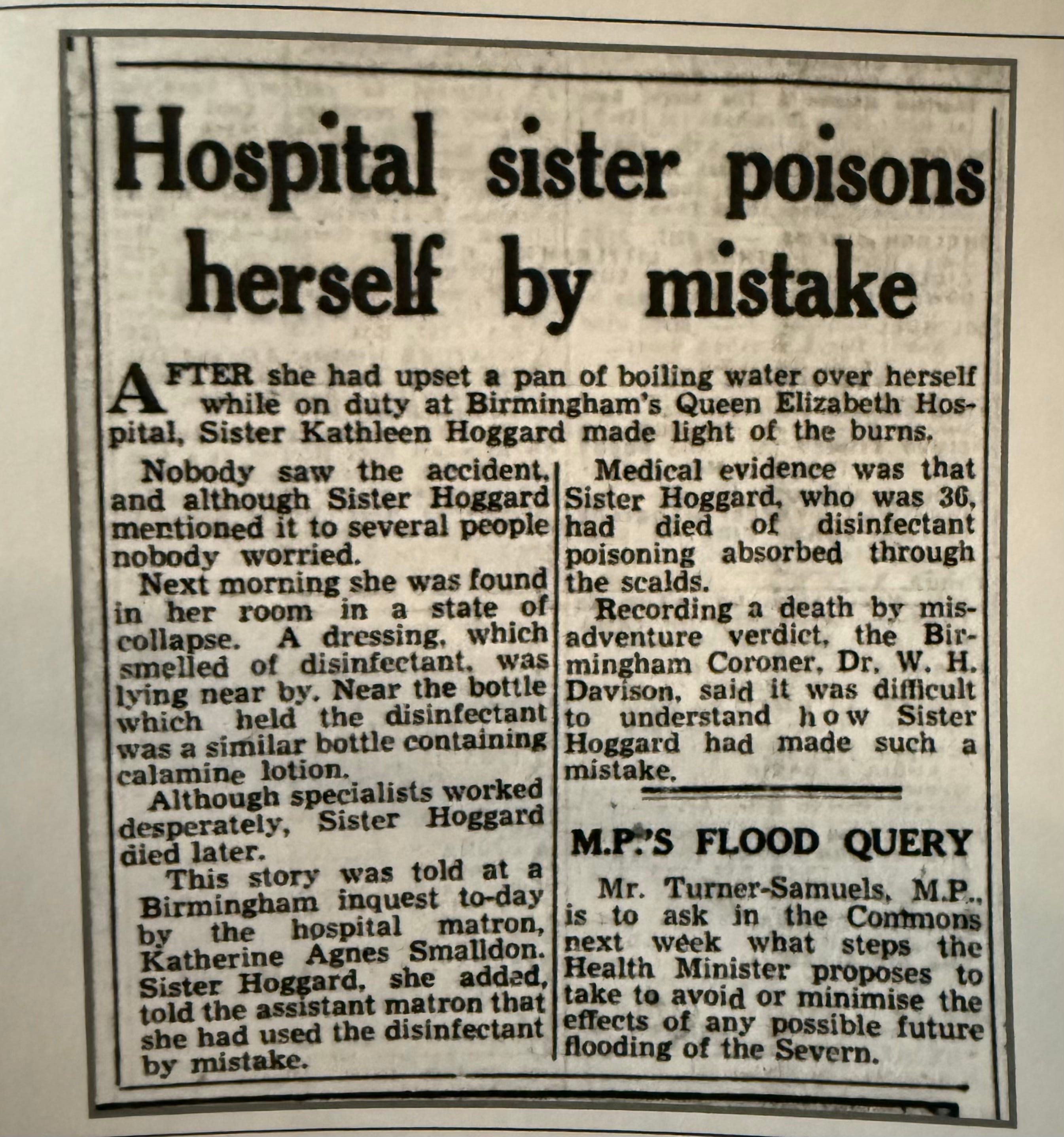
One Sunday in March 1947, tragedy struck. When the Tube Club snuck back through the kitchens, late after a night out, they were told that Sister Hoggard had had an accident whilst making the late night cocoa, tipping a pan of boiling water over and scalding herself badly. “A job we had always done” Stan interrupts his own story, as if wondering “What if we hadn’t gone out?”. In what must have been a blind panic of pain and shock, Sister Hoggard applied disinfectant to the wounds instead of calamine lotion. Dismissing the injury, she retired to bed and was found collapsed in her room the next morning, a disinfectant soaked dressing nearby. Despite the best efforts of staff, she died later that day of disinfectant poisoning absorbed through her scalds. The coroner, a Dr W H Davison, said, rather pompously, “It was difficult to understand how Sister Hoggard had made such a mistake”. I imagine the pale chalky pinkness of calamine and compare it to a milky disinfectant and I wonder if Dr Davison had ever scalded himself. Doreen Tennant speculates in her letter to Stan and I realise she must have had this conversation with her colleagues many times over the years;
“It was before the days of ‘strip lights’. The place where the calamine was kept was in one of the four cupboards outside the big ward. The lighting was poor - in fact, there was only a single light high up between the cupboards - an ordinary one of course and that was, I always wondered, maybe the cause of her dreadful accident. We were, in those days, too VERY economical with electricity and she may not even had had the light on! Oh dear!”
April 1947 brought the arrival of Major Jack Leigh Collis, an eminent and highly decorated surgeon who Stan describes as “blowing through West 5 like a cyclone with his white coat flying behind him”, trailed by young doctors and medical students. ‘Sammie’s Failures’ are all discharged and become outpatients. This is where I have a single memory of my father telling me about his hospital experience;
“He said if I stayed here I would be dead in six months, I was to go out and live my life.”
Collis removed dad’s wasted lung. He went home shortly afterwards. Stan also had his lung removed but had further complications and surgeries, including the removal of a tumour. However he finally returned home for good on 18 February 1952;
“Since then I have flown along, free like a bird.”
Stan went on to marry and have three children and four grandchildren. My father married my mother and they went on to have eight children and twelve grandchildren. A few years later, with the advent of cardiac surgery, Major Jack Leigh Collis was one of the first people to remove a tumour from within the cavity of the left atrium, using a sharpened dessert spoon and a piece of wire gauze. The man was a maverick and a genius and he changed lives, giving the men futures beyond hospital wards and corridors.
They are all gone now. Only a shadow show remains. Stan understood this and illuminated them for a while with his warmth, humour and poetic heart and has the final word at the end of his story with;
“We won in the end!”.
What a price they paid, sacrificing their youth and their health in hope of a better future. Sammie’s Failures triumphed after all, by living.

Writing this made me think of these:
Donald Peers singing In A Shady Nook. Close your eyes and lean in a little closer.
The life of the extraordinary Major Jack Leigh Collis here.
I came across Matt McGinn singing this whilst doing my original research and I find it haunting and lovely.
Online tutored courses with The National Centre For Writing here.
Even though I’ve read this before I cried all over again - so beautifully written Bird xxx
Thanks for this Helen - a lovely read. My family comes from Sutton Coldfield. I wonder if my grandparents knew your dad's friend, Stan?! I find stories of the war and post-war, fascinating.